
GoHighLevel Toll-Free Number Verification: What to Expect
gohighlevel toll free verification 9 min read
How toll-free verification works in GoHighLevel: what the form asks for, how long review really takes, why texts stop while you wait, and common rejections.
- Best for
- HighLevel users who bought a toll-free number to text from and want to know what verification involves, how long it takes and what gets it rejected.
- Not for
- Anyone looking for a faster approval. Nobody, including HighLevel, Twilio, Telnyx or Phone Clover, can speed up the carriers' review.
- The difference
- Phone Clover's registration wizard has its own Toll-free step for numbers on your Telnyx account, next to the 10DLC steps, with each number's status on one screen.
You bought a toll-free number in HighLevel so you could text customers, and the texts won’t send. The number shows a status like “Restricted” or “Pending Verification”, and the help center says the review can take weeks. This guide walks through what toll-free verification actually is, what the form asks for, how long it realistically takes, what happens to your texts and calls while you wait, and the mistakes that get submissions rejected.
What toll-free verification is
Toll-free verification is the carriers’ check on who is texting from a toll-free number (800, 888, 877 and the rest) and why. It exists for the same reason as A2P 10DLC registration for local numbers: US and Canadian carriers want to know the business and the purpose behind business texts before they deliver them.
It is a separate process from 10DLC. HighLevel says it directly: “Toll-Free Verification is not A2P 10DLC registration.” Toll-free numbers don’t need a brand and campaign. They get one verification per number, reviewed on its own track.
That difference is why some businesses pick toll-free in the first place: there is no campaign fee, and HighLevel’s guide says no EIN is required on its side. It is also why finishing one process never clears the other. If a sub-account texts from both local and toll-free numbers, both reviews have to be done.
Where you start it in HighLevel
In LC Phone, HighLevel’s guide puts it here: Settings, then Phone System, then Manage Numbers, then Verification Required under the toll-free number. HighLevel shows one of four statuses per number:
| Status | Can it text US and Canadian recipients? |
|---|---|
| Restricted (Unverified) | No |
| Pending Verification | No |
| Verified (Approved) | Yes |
| Rejected | No |
Only a verified number can text US and Canadian recipients. That is the part that catches people out, so it gets its own section below.
What the form asks for
HighLevel’s form runs in three stages: business identity and contact details, the physical business location, and the use case with proof of consent. In plain terms, you need:
- The business’s exact legal name, matching public records.
- A public website or social profile for the business.
- Contact details and a physical address.
- The use case. What you text people and why.
- How people opt in, choosing from web form, paper form, text, verbal or mobile/QR code, plus evidence of it. HighLevel’s rule: “The verification URL must be accessible to a reviewer without signing in.”
- Sample messages that include the business name, the context and opt-out language.
- An estimated monthly volume.
The reviewer checks that all of this agrees with itself. A name that doesn’t match the website, or sample messages about appointments when the use case says marketing, is where most rejections come from.
How long it really takes
This is the question everyone searches, and the sources don’t agree:
| Source | What it says |
|---|---|
| HighLevel’s current guide | “Review can take up to four to six weeks, although some submissions finish sooner; approval timing is not guaranteed.” |
| HighLevel’s older changelog | “Usually completed in around 3 business days but may sometimes take some more time.” |
| Twilio’s developer docs | Twilio “reviews TFV requests within three business days.” |
| Telnyx support | “Normally 5 business days or less but can be faster or slower depending on volume.” |
| Telnyx developer docs | “Total first submission: 1–2 weeks”, and “Expedited review is not available.” |
The honest reading: a clean submission often clears in days to a couple of weeks, and HighLevel says it can take up to six weeks. A rejection and resubmission restarts part of the clock. Plan your launch around the long end.
What nobody can do is make it faster. Not HighLevel, not your carrier and not Phone Clover. Anyone who promises a quicker approval is promising something they don’t control.
What happens while you wait
Texts are blocked. Since January 31, 2024, texts from toll-free numbers in a restricted or pending state don’t go out. Twilio’s error 30032 documents the block, and HighLevel lists the same error for unverified toll-free sends. HighLevel also warns that “applicable messaging charges can still apply to accepted delivery attempts”, so a workflow that keeps firing texts from a pending number can still cost you money without reaching anyone.
You may still find older posts describing daily limits for pending numbers. Those were real in 2023 and were replaced by the full block, so don’t plan around them.
Calls keep working. HighLevel’s guide says toll-free verification “does not prevent the number from being used for voice calling.” Your toll-free line keeps ringing and can keep calling out while the texting side is under review.
Plan the gap. If you need to text customers during those weeks, use a local number that is already on an approved 10DLC campaign, or pause the automations that would text from the toll-free number until it is verified.
The EIN question
This is where current sources disagree, so it is worth being careful.
- HighLevel says: “A business tax ID or EIN is not required to complete Toll-Free Verification.” It removed the requirement in 2025.
- Twilio, the carrier behind LC Phone, published that “starting February 17, 2026, a business registration number for all business types except sole proprietorships will be required for all new Toll-Free submissions.”
- Telnyx announced in October 2025 that its business registration fields would become mandatory for new toll-free verifications in 2026.
- HighLevel’s rejection list also includes code 30527, the rejection for a missing or invalid business registration number.
As of September 2026, we couldn’t confirm which rule HighLevel’s form applies to your submission. The safe move is the same either way: if the business has an EIN, have it and the exact legal name ready. Twilio’s advice on 30527 is to enter the legal name exactly “as it appears in your official registration records”, not a DBA or an abbreviation, and to wait for a new EIN to clear IRS matching first.
Common rejection reasons and how to fix them
HighLevel shows the rejection reason on the Phone Numbers page. These are the ones HighLevel’s and Telnyx’s lists have in common, most of them fixable:
| Rejection | What it usually means | The fix |
|---|---|---|
| Business info or website can’t be verified | The name, address or site doesn’t match public records | Use the exact legal name and a live site that shows it |
| Insufficient opt-in consent | The reviewer can’t see how people agreed to texts | Link a public page or image showing the opt-in and its wording |
| Opt-in page behind a login | The reviewer can’t open it | Put the proof on a public URL |
| Samples don’t match the use case | Marketing samples on a “notifications” program, or the reverse | Rewrite samples to match what you will actually send |
| Samples missing opt-out language | No “Reply STOP to opt out” or similar | Add opt-out wording to every sample |
| URL shorteners or insecure links | Shortened or non-HTTPS links in samples or proof | Use full HTTPS links on your own domain |
| One number used by several businesses | An agency number shared across clients | One business per toll-free number |
| Volume doesn’t fit the use case | A tiny business declaring huge volume, or the reverse | Declare a realistic monthly estimate |
Telnyx’s troubleshooting advice is good: fix only the reason that was cited, and don’t rewrite the whole submission.
Two limits on resubmitting. HighLevel’s rejection list says a rejected submission expires if you don’t respond within 7 days. And some content can’t be resubmitted at all: HighLevel’s list names the restricted categories carriers group as SHAFT (sex, hate, alcohol, firearms, tobacco), plus gambling, crypto, debt services and third-party lead generation.
Most of these reasons overlap with 10DLC rejections, which we cover in more depth in why your GoHighLevel 10DLC campaign got rejected.
Toll-free or 10DLC?
Both work. The choice is about what you send and who is sending it.
| Toll-free | 10DLC local number | |
|---|---|---|
| Registration | One verification per number | Brand plus campaign |
| EIN on HighLevel’s form | Not required, per HighLevel | Required for most brands |
| Looks local to the customer | No | Yes, with a local area code |
| Good fit | National brands, support lines, businesses that can’t verify a brand | Local businesses, sales and follow-up |
If a sub-account already has an approved 10DLC campaign, adding toll-free is usually only worth it for a specific reason, such as a national support line. If a business keeps failing brand verification, toll-free can be the practical path. Either way, it is not a shortcut. For how the two fit together across many clients, see A2P 10DLC for HighLevel agencies.
How it works in Phone Clover
Everything above is about toll-free numbers on LC Phone. If the number is on your own Telnyx account through Phone Clover, a private HighLevel app in early access, verification goes through Telnyx instead of HighLevel’s LC Phone form, under the same carrier rules.
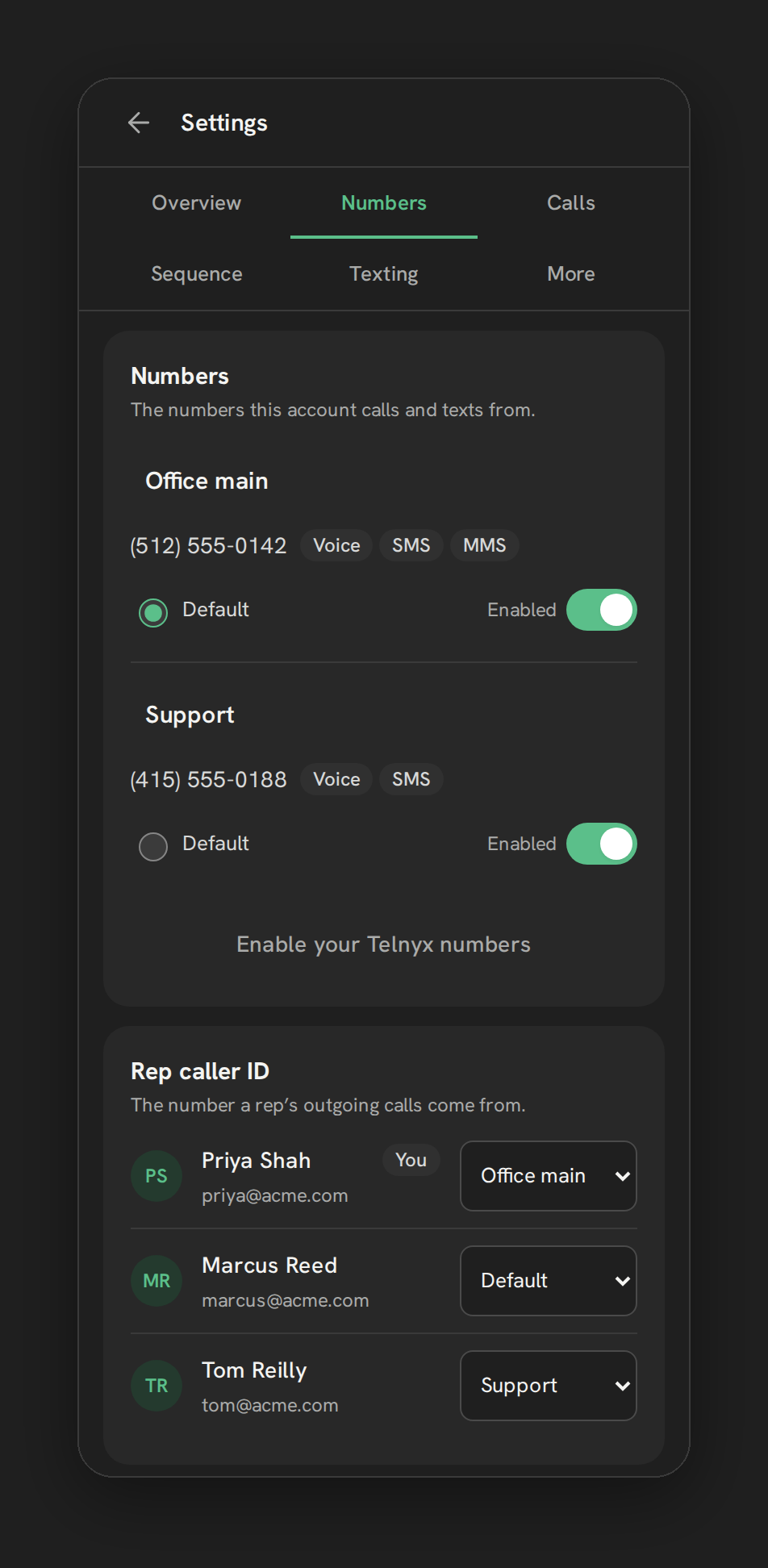
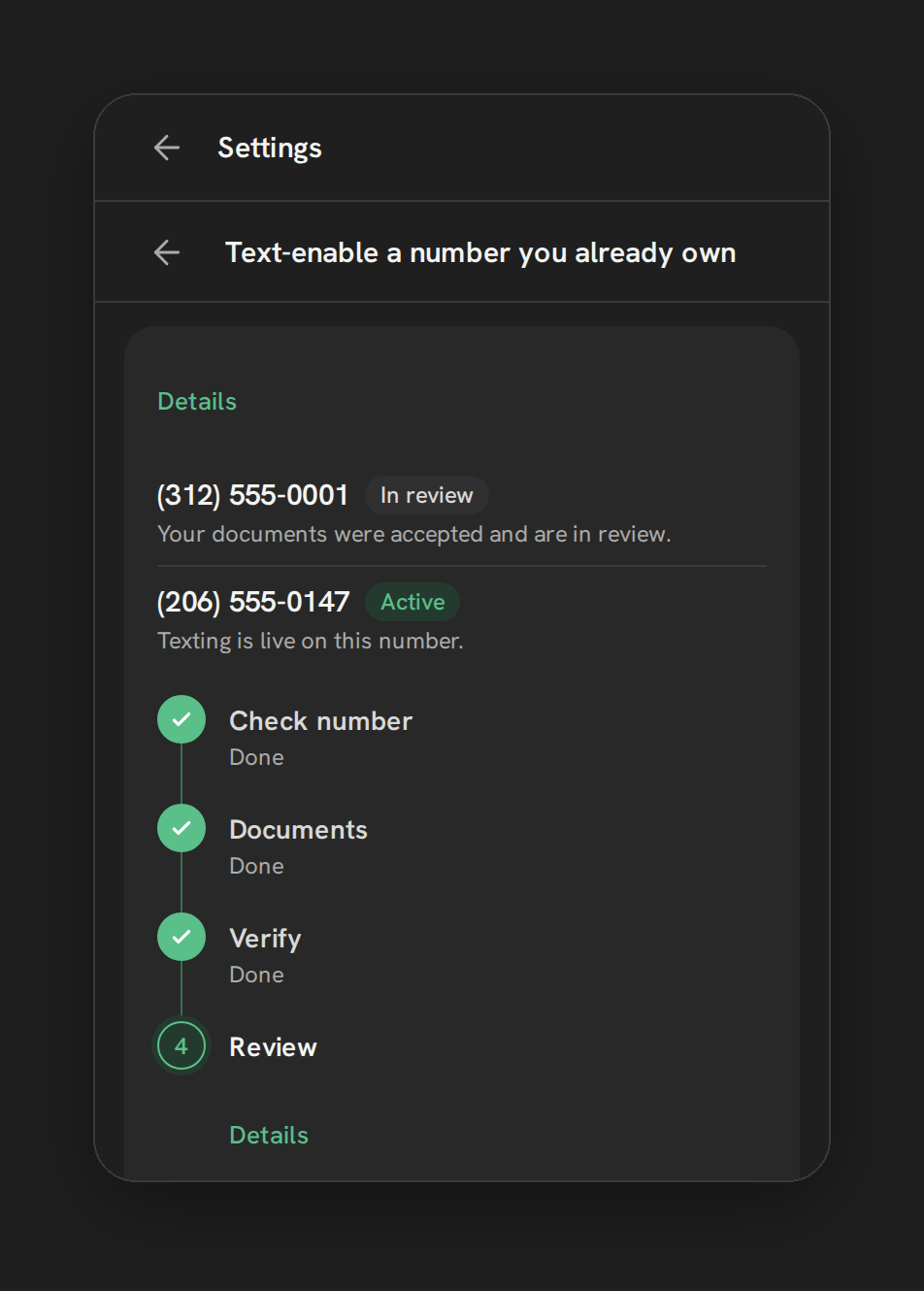
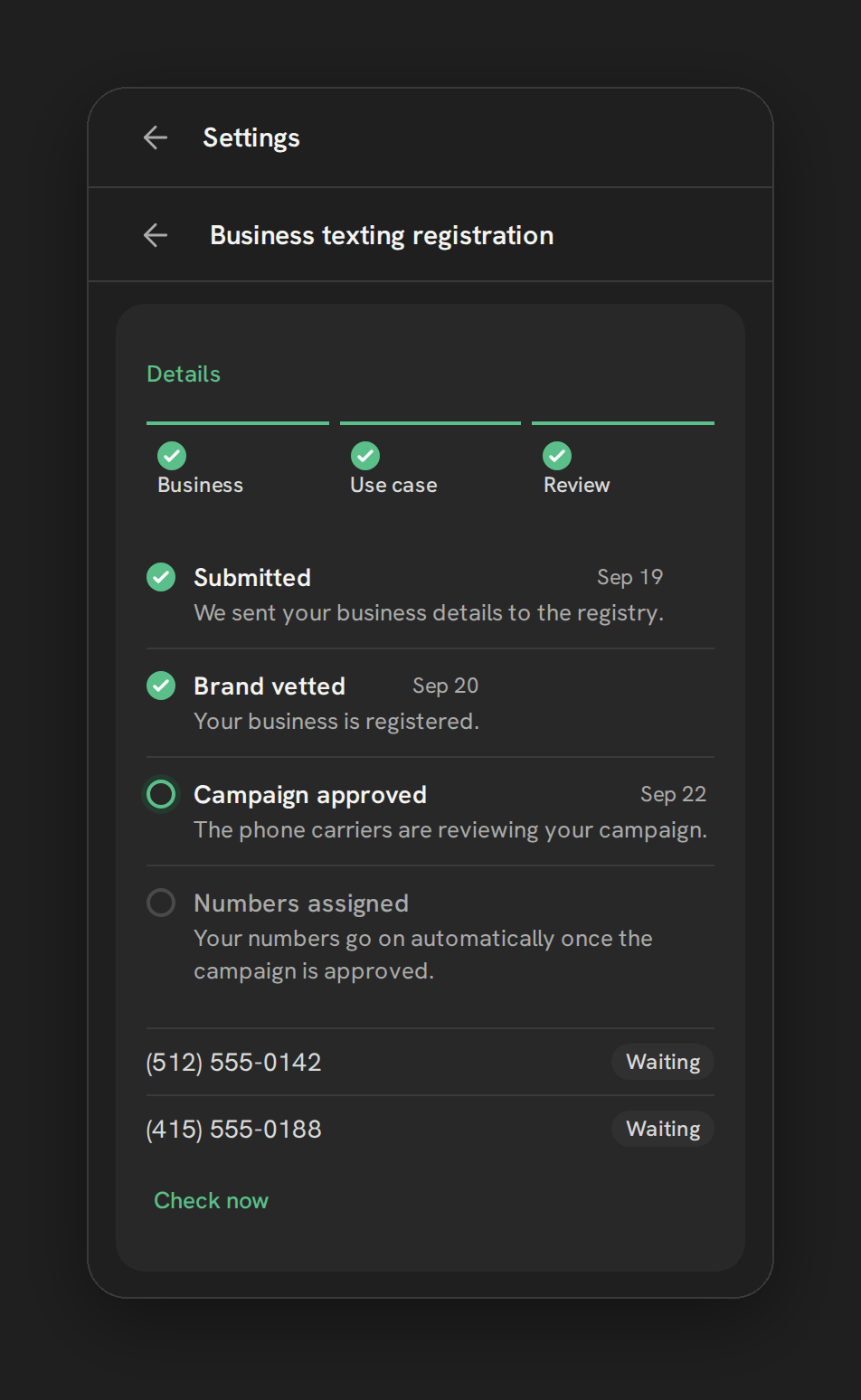
In the app, an admin opens Settings, then the Texting tab, then Business texting registration. The wizard has Business, Use case and Review steps for 10DLC, and a separate Toll-free step with its own verification form. That step appears only if the account has a toll-free number. The Review step shows a status timeline, a Fix and resubmit button when something fails, a Registered or Waiting chip for each number, and a Check now link.
Honest limits:
- The review is still the carriers’. The wizard gathers the details and submits them; it can’t shorten the review, and we never promise it will.
- It is in early access. The wizard is built, but the registration has not been completed on our own pilot account yet, and texting through HighLevel Conversations on Telnyx runs in that pilot today. Workflow and bulk texting are not proven yet.
- Pending still means no texting. The carrier rules above apply on Telnyx exactly as on LC Phone.
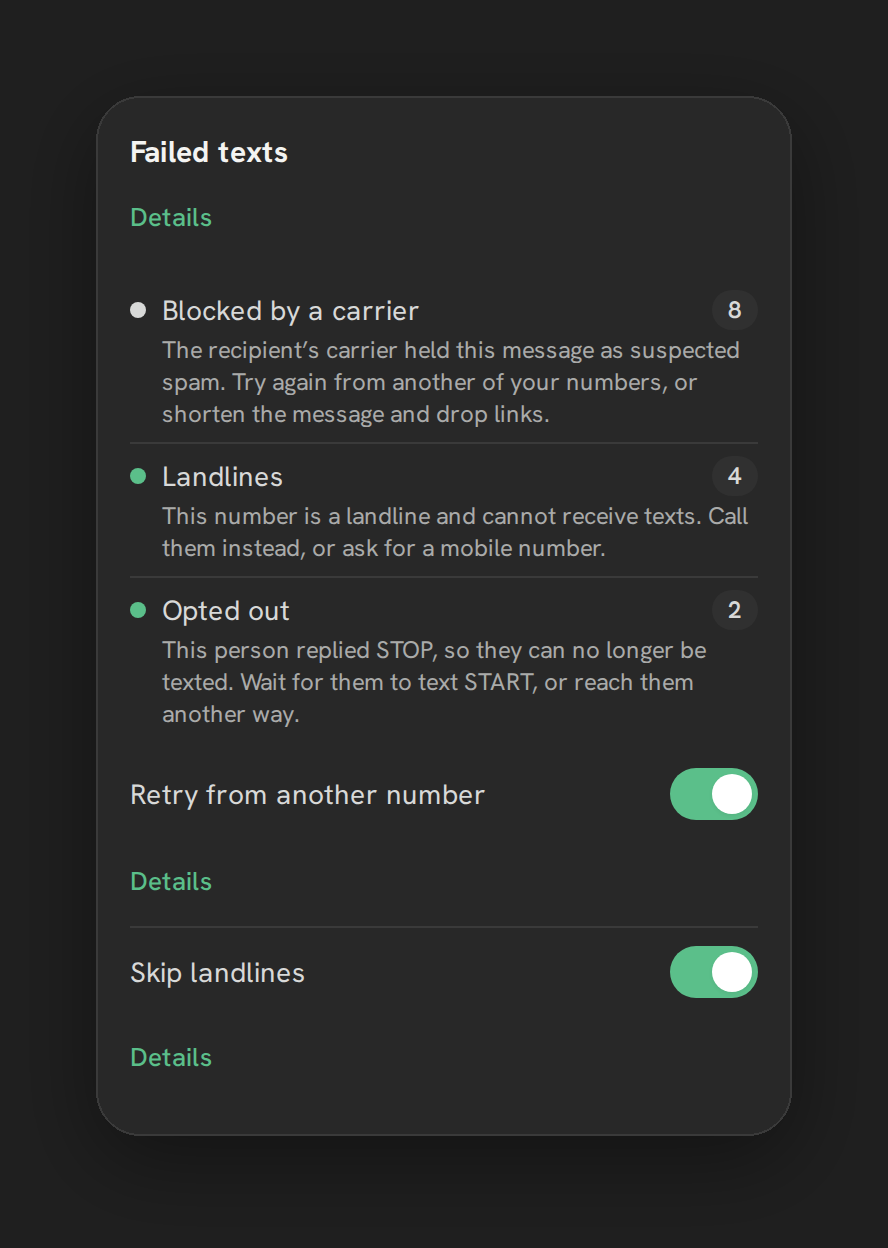
See the A2P 10DLC and toll-free registration page and the step-by-step registration guide. Once numbers are live, the failed-text reasons screen tells you in plain English when a carrier filters a message.
A checklist before you submit
- The legal name matches your registration records exactly, with no DBA and no abbreviation.
- The website loads over HTTPS and shows that business name.
- The opt-in proof is on a public URL, with no login.
- Every sample message names the business and includes opt-out wording.
- No shortened links anywhere.
- The use case, samples and declared volume tell the same story.
- One business per toll-free number.
- The EIN is ready, even if the form doesn’t ask for it.
- Automations that text from this number are paused until it shows Verified.
Where this leaves you
Toll-free verification is paperwork with a waiting period attached. Get the business details consistent, make the consent proof public, write honest sample messages and expect weeks rather than days. Your calls keep working the whole time; your texts wait.
For the wider picture of texting on your own Telnyx numbers, see Texting on Telnyx and Telnyx for GoHighLevel. If deliverability after approval is the next worry, read how to improve SMS deliverability in GoHighLevel. And if you are sending to customers outside North America, alphanumeric sender IDs follow a different set of rules entirely.